
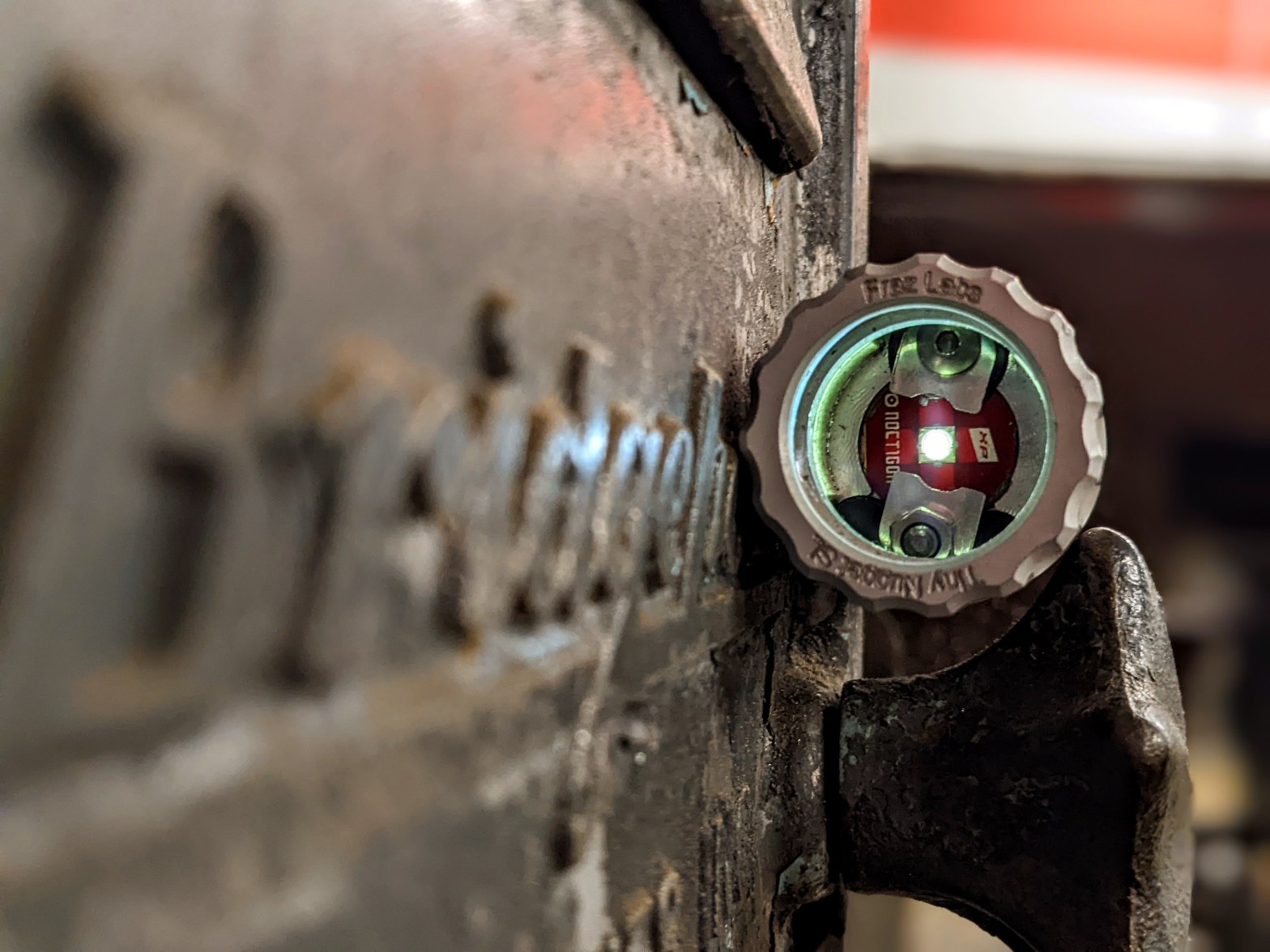
Have you ever had a flashlight ruin the filming of a slomo video, taking it from tech wonder to techNO? Maybe it felt like some vague eye strain after using a light during a power outage, or a long hike? That’s PWM, y’all, and that fun little flicker is nothing short of annoying.
Pulse Width Modulation (PWM) is what most modern LED flashlights use to control the brightness level being used at any moment. Instead of actually reducing the power going to the LED, the PWM switches on and off very rapidly – hundreds or thousands of times a second. This is way too fast for most people to consciously see with their eyes, but not fast enough to fool your brain.
At full brightness, the light is on 100% of the time. At half brightness, it’s flickering off and on at 50%. At low brightness, it’s off more than it’s on. The dimmer the setting, the more aggressive the flicker. This is where the problems arise for some people, anything from eye strain to epileptic seizures. And I can’t tell you how many slow motion videos I’ve tried to film and ruined it with the PWM ‘death roll’!!
Our argument is this – why make it complicated if it doesn’t have to be?! PWM requires a driver, firmware, or microcontroller. No matter which you pick, that’s a lot of possible failure points. So, why does nearly every flashlight use it? Because it’s cheap and easy! A driver costs pennies and can be customized for all sorts of neat modes like strobe and SOS. They’re also easy to implement into most flashlight designs, so there’s less R&D involved. However, a driver is just a tiny computer chip. Possibly a chip full of failure…
What’s the alternative, you ask? Analog dimming, of course! Instead of flipping the LED off and on, analog dimming actually limits the current flowing to the LED, reducing the brightness smoothly and steadily with no annoying rolling flicker to ruin your day in any way.
It’s a simpler system, it’s better for your eyes, and it’s the best thing for the durability department. For as awesome as it is to use, it’s equally challenging to implement, especially in a small EDC package. There’s nothing to program, it’s all hardware. A physical mechanism has to actually change the electrical resistance between the battery and the LED.
This is where we come in.
This team-of-two designed a piston based system (Patent Number 10,121,576 : ‘Pressure based, mechanical amperage control engine for an electronic device’) that uses quantum tunneling composite, a smart material that changes its electrical resistance when pressure is applied. The more it’s squished, the more current flows, which means more light. This is how our flashlights have infinite brightness levels with zero PWM, and zero chance of any electronics breaking.
Tighten to brighten, loosen to dim, and you’ll never have to curse the flicker again. If this sounds like something you’ve been looking for, you can find our full lineup here.